Showing posts with label USA. Show all posts

Sunday, 9 August 2015

Why Cannabis Should be Illegal

So what are the dangers of smoking cannabis?
Source: www.livescience.co.uk
Not even the most diehard advocates of legal cannabis would make the claim that the drug has no harmful effects. Whilst it may be enjoyable in moderation, consuming it excessively can cause illness and sometimes even death. In 2013 in the United Kingdom over 8,000 people lost their lives due to cannabis, according to the Office for National Statistics (ONS). Furthermore in the United States the Centre for Disease Control (CDC) reports that excessive cannabis consumption led to 88,000 deaths and 2.5 million “years of potential life lost” (This is calculated by deducting the age people died at due to cannabis consumption from the life expectancy). The same report reveals that, shockingly, excessive smoking was responsible for a staggering 1 in 10 deaths amongst working age adults (20-64). Even if you only consume a little at a time, getting high frequently can still have long term health implications.  

Yet the cost of marijuana to our society goes beyond the deaths of the people who consume it. Due to cannabis being a depressant, smoking and driving is another huge problem with an average 3,000 people getting killed or seriously injured annually in the UK thanks to smoke-driving. Furthermore there is a huge economic cost to excessive cannabis consumption; according to the Institute for Cannabis Studies (ICS) and a government report it sits at a staggering £21.8 billion annually. Of this £3.5 billion due to an increased burden on the NHS, £11 billion thanks to cannabis related crime, and an incredible £7.3 billion in lost productivity! On the subject of crime more than 40% of all violent crime committed in the UK has been committed whilst the perpetrator was high (according to the ICS).

Yet looking at statistics alone doesn’t cover the harm caused by marijuana. The biggest burden is felt by the addicts, their families, and their friends. Cannabis is often a contributing factor in abusive relationships, and many families break down as a result. A huge proportion of homeless people in the UK are there thanks to their addiction to cannabis. Every year people lose their jobs, their spouses or their children to cannabis abuse, and yet still people want legal marijuana.

You’re shocked, right? Well I promise you that all the above data is absolutely 100% true… Just not about cannabis. The drug I was actually writing about was alcohol, which is perfectly legal. Replace all references to cannabis/smoking/high with alcohol/drinking/drunk and it will make a lot more sense. The fact is alcohol is a much more destructive drug, to both an individual and society, than marijuana. Yet you will get many prohibitionists decrying the legalisation of cannabis whilst at the same time planning to get blind drunk at the next work Christmas party. They are completely blind to their own hypocrisy, and it is simply astounding.

If you want to continue to support supporting the ludicrous war on drugs, and in particular the ludicrous war on marijuana. Fine*. I just hope that you’ll be consistent in applying your logic and join the temperance movement.

*Well actually it’s not fine, I’ve written why it’s not fine here.  

Sources:

Cannabis related deaths (UK): http://bit.ly/1gUxEEv

Smoke-driving deaths (UK): http://bit.ly/1BtB7kH

Marijuana consumption in the US: http://1.usa.gov/1d7aWk2

Economic Impact of cannabis abuse (UK): http://bit.ly/1pmE13L


Crime and cannabis: http://bit.ly/1IQTVJ6

Wednesday, 11 February 2015

The Hypocrisy of Liberals and Conservatives

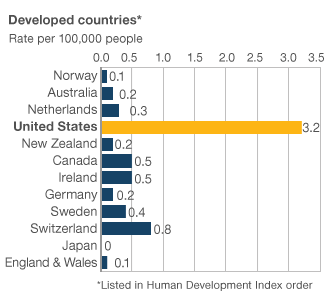
The huge amount of people killed by
guns is unique to America in the
developed world.
Source: BBC
According to the CDC in 2013 there were 11,208 firearm homicides, or 70% of the total homicides committed in the United States.  This number is not even close to the total number of people who were killed by firearms in 2013, which stood at a colossal 33,363. Despite this huge problem, the debate over gun laws is a hugely divisive debate.


Many Americans, mostly on the conservative side of the spectrum, will attack any law that restricts the proliferation of firearms as unconstitutional due to the second amendment. Whilst federal gun laws are arguably the weakest they have ever been, for many gun lovers, they are still too strong. Furthermore, despite the failure of the Senate to pass new gun regulations in 2013, many gun rights activists are terrified that the government is going to confiscate their guns.  As a result of the hysteria, many red states have gone ahead and tried to nullify federal gun laws.

In 2014 the Washington Post pointed out that “In Idaho, the Legislature unanimously passed a law to keep any future federal gun measures from being enforced in the state. In Kansas, a law passed last year says federal regulation doesn’t apply to guns manufactured in the state. Wyoming, South Dakota and Arizona have had laws protecting “firearms freedom” from the U.S. government since 2010.”

The nullification of federal laws outraged many liberals who decried the efforts as unconstitutional. However I find that many of these same liberals are perfectly happy to advocate nullification in an area that suits them: Marijuana laws.

Source: Pew Research
The federal government classifies marijuana as a schedule 1 drug, which means that it has a high potential for abuse, it has no medical value, there is no way to use the drug safely consume it under medical supervision, and no prescriptions may be written for it. Now whilst you may take issue with this classification (I believe marijuana should be legalised), that is not what this article is about. Whether you like it or not, this is federal law in the United States as it stands today.

As a result of the federal government’s ridiculous laws on marijuana, many states have effectively tried to nullify federal law on the issue. As it stands now 19 states have legalised medical marijuana, 14 have decriminalised possession and four (plus Washington D.C.) have legalised marijuana for recreational purposes. This is a direct violation of federal laws. Many conservatives have railed against the wave of marijuana legalisation in states across America, frustrated that they have effectively nullified federal law.

So my question to liberals is this: why is it acceptable to nullify federal laws on marijuana but totally unacceptable to nullify federal gun laws? And for conservatives, why is it acceptable to nullify federal laws on guns but totally unacceptably to nullify federal marijuana laws?

These questions have totally stumped me, I can't think of a way for liberals or conservatives to justify their respective beliefs. If anyone would be kind enough to offer me an explanation, other than the obvious that people support whatever results in them getting their way, that would be great! 

Saturday, 7 February 2015

If You Thought 2012 Was Messy, Just Wait For 2016

If you remember anything from the 2012 Republican primaries, it is likely that you remember just how much of a mess it was. The debates were especially memorable, in part because there were so many of them, but mostly because of the gaffes of the candidates and the actions of the audiences.

The crowded field hurt the Party significantly in 2016
source: www.slate.com
Rick Perry completely derailed his bid when he declared “It’s three agencies of government when I get there that are gone; commerce, education and the… um…” it took him 15 minutes to remember that the third was energy. Mitt Romney showed himself to be completely out of touch with the ordinary American when he offered Perry a bet of $10,000. When one of the moderators asked Perry about the huge amount of executions that he had signed off on as governor (234, by far the largest amount of any governor in modern times) he received a resounding applause from the audience. The audience also booed a former solider because he was gay and when Ron Paul was asked whether or not he would be prepared to let a man die because he didn’t have health insurance, the audience enthusiastically shouted “YES”! I could go on, but I feel you get the picture.

The primary was also a mess due to the huge amount of candidates that led the polls for a short amount of time. Rick Perry, Newt Gingrich, Mitt Romney, Herman Cain and Rick Santorum all led the polls for periods of time leading to absolute media frenzy. Michele Bachmann was also considered to have a real chance after she won the Iowa Straw Poll (despite the fact that it has no indication of real support, as votes are effectively bought).

Will the 2016 primaries be any different to the mess that was 2012? Well yes and no. Firstly the Republican Party has learnt from the mistake of having far too many debates, in 2016 there will only be ten official debates. Any candidate who decides to participate in unofficial debates, will be “sanctioned”.

However the cavalcade of comedy that was the Republican Primary will likely repeat itself in 2016. One of the problems is that there is no ‘obvious’ candidate for the Republican Party in the way that Hilary Clinton is the ‘obvious’ candidate for the Democratic Primary. As a result the field is wide open to any Republican with presidential ambitions. At the moment I would say there are no fewer than 11 potential front runners. That number is about double the amount of front runners in 2012. This would make it an even bigger farce than 2012. The crowded field also means that Republicans will coalesce around their candidate far later than Democrats (assuming Hilary does win), further weakening their chances of winning the presidency.

Jeb Bush: He is the former governor of Florida and son of former President George H.W. Bush. Despite his family name, his moderation and support for comprehensive immigration reform make him the best hope the Republicans have of winning in 2016. Whether they actually choose him is another kettle of fish entirely. Very likely to run

Ben Carson: Carson is a Tea Party hero and a very smart guy (he is a neurosurgeon after all), and as a black man he is frequently held up by the Tea Party as evidence that they are not racist. However he has never held elected office before and I doubt will actually win the primary. If he did he would lose the Presidential election to even the weakest Democrat.  Very likely to run

Chris Christie: Before his administration (he’s governor of New Jersey) became engulfed in scandal after scandal, most people felt that he had the best shot of winning the primary. Unfortunately for Christie several scandals have completely jeopardised his chances. Despite this I rate him very likely to run.

Ted Cruz: Another darling of the Tea Party, Cruz has established himself as one of the most conservative and radical Senators since he won election in 2012. In 2013 he was one of the primary causes of the government shutdown that infuriated Americans. It is interesting that so many of the birthers that considered Obama ineligible to be President because they believed, without evidence, that he was born in Kenya, support Cruz despite being born in a foreign country (Canada). Of course the colour of their skin totally doesn't have anything to do this inconsistency. Almost certain to run

Mike Huckabee: Huckabee first ran for the Presidency in 2008 before losing to John McCain. He recently left his lucrative job at Fox News, leading many to speculate that he was preparing himself for a Presidential bid in 2016. Probably will run

Bobby Jindal: He is the current governor of Louisiana and has been rumoured to have been mulling a run for the Presidency for years. He recently attended a prayer rally held by the American Family Association (which the Southern Poverty Law Centre defines as a hate group) in Louisiana; Rick Perry used a similar event to help launch his (first?) failed presidential bid. Might run

Rand Paul: He is the son of Ron Paul and has inherited a lot of his father’s support from the libertarian wing of the Republican Party. However he is both more moderate and electable than his father. Interestingly if he does run he will be unable to run for re-election to Senate, even if he loses in the primary. This means that he takes a huge risk by running in 2016! Almost certain to run

Rick Perry: Yes, he is seriously hoping to run again in 2016. His chances, however, are slim to none. Might run

Marco Rubio: For the first half of 2013 Rubio looked like he had a real shot at the presidency, easily outpacing his opponents according to the Huffington Post’s average of polls. However since then he has largely dropped off the radar. Might run

Paul Ryan: Despite being a member of the establishment, Ryan is on good terms with the Tea Party base. This kind of support could work very well in a primary election; add to that the visibility he was lent when Mitt Romney chose him as his running mate in 2012, he could be a strong candidate. Despite this he is not polling strongly, which could result in him skipping the race. Considering his relative youth (he’s 45), there will be plenty of future potential races. Might run


Scott Walker: The governor of Wisconsin could prove a real player in next year’s primaries if he decides to run. However the scandals in his administration would receive far more news coverage than they have currently, which could trough a spanner into the works for Walker. Might run

Friday, 2 January 2015

Same-Sex Marriage Becomes ‘the Norm’ in American States

The expansion of marriage rights has made great progress in 2014. In total 18 states expanded marriage rights to same-sex couples, entirely through the courts system.

The first of these cracks opened up in December 2013 when, to everyone’s surprise, a federal judge in Utah ruled that the state’s same-sex marriage ban was unconstitutional. Although it was stayed pending appeal, it set the state for what 2014 would become: a battle in the courts for gay rights.

14th January – Oklahoma ban ruled unconstitutional
23rd January – Virginia Attorney general stated that he would not defend the state’s ban
10th February – Nevada Attorney General stated that she would not defend the state’s ban
12th February – Kentucky told to recognise same-sex marriages performed in other jurisdictions
13th February – Virginia ban ruled unconstitutional
25th February – Texas ban ruled unconstitutional
21st March – Michigan ban ruled unconstitutional
9th May – Arkansas ban ruled unconstitutional
13th May – Idaho ban ruled unconstitutional
19th May – Oregon ban ruled unconstitutional, state did not appeal ruling legalising same-sex marriage immediately in that state
20th May – Pennsylvania ban ruled unconstitutional, state did not appeal ruling legalising same-sex marriage immediately in that state
6th June – Wisconsin ban ruled unconstitutional
25th June – Tenth Circuit Court rules that Utah’s ban is unconstitutional, Utah appeals to the Supreme Court
25th June – Indiana ban ruled unconstitutional
1st July – Kentucky ban ruled unconstitutional
9th July – Colorado state judge rules that the state’s ban is unconstitutional
21st July – Florida ban ruled unconstitutional, stayed until the 5th of January
28th July – Fourth Circuit Court affirms Virginia’s ban as unconstitutional
3rd September – Louisiana’s ban ruled constitutional, the first set-back thanks to a court for same-sex marriage rights in 2014
4th September – Seventh Circuit Court affirms that Indiana and Wisconsin bans are unconstitutional
6th October – The Supreme Court declines to hear appeals in Utah, Oklahoma, Indiana, Wisconsin and Virginia

The Supreme Court’s decision on the 6th of October was huge, by refusing to hear the appeals it effectively upheld the lower courts’ rulings and meant that same-sex marriage was now legal in those five states. This meant that for the first time in American history a majority of Americans lived in states with legal same-sex marriage! Yet the ruling would not only affect those five states, any states without same-sex marriage who were under the jurisdiction of 4th and 10th Circuit Courts (there were none left without same-sex marriage under the 7th Circuit Court) were at risk of losing their bans. Over the next couple of months the six states this applied to (Colorado, Kansas and Wyoming for the 10th and North Carolina, South Carolina and West Virginia for the 4th) all had their bans overturned, whether by court action or instruction of the state government.

7th October – Ninth Circuit Court rules that Idaho and Nevada bans are unconstitutional*
7th October – Colorado Attorney General asks 10th Circuit Court and the state Supreme Court to dismiss his appeals on earlier rulings, they comply immediately
8th October – Some counties in Kansas and South Carolina issue same-sex marriage licenses
10th October – North Carolina ban ruled unconstitutional, judge citing the 4th Circuit’s precedence
12th October – Alaska ban ruled unconstitutional
17th October – Arizona ban ruled unconstitutional
17th October – Wyoming ban ruled unconstitutional (stay lifted on the 21st of October)
4th November – Kansas ban ruled unconstitutional (stay lifted on the 12th of November)
5th November – State judge ruling in Missouri results in St. Louis issuing same-sex marriage licenses
6th November – Sixth Circuit Court upholds same-sex marriage as constitutional
7th November – Missouri ban ruled unconstitutional, Jackson County (Missouri’s second largest) begins to issue same-sex marriage licenses
12th November – South Carolina ban ruled unconstitutional (stayed until 20th of November)
19th November – Montana ban ruled unconstitutional
25th November – Mississippi ban ruled unconstitutional
19th December – Supreme Court declines to hear Florida’s appeal, marriages will begin on the 6th of January


The 6th Circuit Court’s ruling on the 6th of November is especially important as it was the only circuit court to rule against same-sex marriage. This created a circuit split, which means that the Supreme Court has no choice but to rule on the constitutionality of same-sex marriage. This is why I believe that same-sex marriage will become legal in all 50 states by the end of 2015.

Democrats Suffer Worst Mid-Term Defeats in a Generation

The November elections went horrendously for the Democrats, suffering their worst mid-term defeat in recent decades. In the Senate they lost nine seats, the worst defeat of any party in the Senate since 1980, when the Democrats lost 12 seats. In the House of Representatives the Republicans enlarged their majority by making a net gain of 13 seats. The defeat of Democrats in governor races was especially stinging, given the unpopularity of many Republican Governors. The only governor Democrats managed to unseat was Tom Corbett in Pennsylvania. However Republicans managed to gain Arkansas as well as three of the bluest states in the country: Illinois, Maryland and Massachusetts! The Democrats also lost badly in other state level races across the country leaving the party with control of the fewest states since the Civil War!

There were a few bright spots for liberals; Alaska, Oregon and Washington D.C. all voted to legalise marijuana whilst Alaska, Arkansas, Illinois, Nebraska and South Dakota all voted to raise the minimum wage. In Alaska the Independent-Democrat fusion ticket for Governor and Lieutenant Governor ousted the incumbent Republicans. In New Hampshire Democratic Senator Jeanne Shaheen managed to hold off against Scott Brown, making it the only race that was expected to be close that the Democrats actually won. However that was cold comfort for the many Democrats defeated on election night.

There are many reasons why the Democrats lost so badly. The Senate was always going to be an uphill battle due to the number of races held in states that Obama lost twice. Yet the Democrats did worse than they should have, even then. One of the reasons was the abysmal turnout in 2014, at 36.4% it was the lowest turnout since 1942. If you know your history that was in the middle of WWII, when many Americans were a bit too busy fighting to vote. Low turnout tends to hurt Democrats as major elements of their base are even less likely to vote, such as Hispanics and young people.


As a result of the elections Republicans now have control of the Senate and therefore Congress. What they do with this power will have huge implications for the Presidential election in 2016. It also matters a lot for Obama’s judicial nominees who require the approval of the Senate. If a Supreme Court position opens up between now and 2016, expect a truly huge fight.

Obama's party was handed a heavy defeat in the November elections
source:uptownmagazine.com

Thursday, 1 January 2015

Police Brutality Divides America

America has had a problem with police brutality for a long time. Every year hundreds of people die at the hands of American police and many more are beaten up. In 2014 alone at least 587 people were killed by cops. You can see a graph of this below.

What galvanised Americans was the shooting of black teenager Michael Brown in the town of Ferguson, Missouri by white police officer Darren Wilson. The fact that Brown was unarmed and the belief that he was running away when Wilson started shooting and then put his hands up to surrender infuriated folks in Ferguson. The latter led to the protest slogan “hands up, don’t shoot”. Pretty soon the whole country was transfixed by what was happening in Ferguson and protests started springing up all across America. Many people noted that police officers in the United States disproportionately target black males, leading the protests to take a racial angle. Eventually the Prosecuting Attorney, Robert McCulloch, decided to convene a grand jury to decide whether or not to indict Officer Wilson in the death of Mike Brown.

The grand jury decided on the 24th of November to not indict Officer Wilson, which led to huge protests throughout America. As people have looked deeper into how McCulloch performed his job, it has become pretty clear that he threw the case. He used a ‘witness’ who was a known liar to the Attorney to back up Wilson’s testimony. McCulloch has even admitted that he knew that she lied, but he still put forward her testimony! He also gave the grand jury a copy of a Missouri state law which stated that police officers were allowed to shoot fleeing suspects. This is particularly important in the Brown case as there is a lot of witness testimony that states that Brown was fleeing when Wilson began shooting. However laws like that had been ruled unconstitutional by the Supreme Court in 1985!

As protests were ongoing we learnt of a 12 year old boy called Tamir Rice from Cleveland, Ohio who had been shot and killed by a police officer a couple of days before the news about Wilson getting away with killing Brown broke. He had been shot by cops less than two seconds after police pulled up beside him. He was on his own, he was 12, he was not a threat to anyone, and cops killed him. It makes me feel physically sick. Then to add fuel to the fire news broke that a grand jury in Staten Island, New York had decided not to indict police officers involved in the death of Eric Garner. There is video footage of Garner’s death that shows just how awfully the police officers involved behaved. You can clearly see that it is the police officers who started, then escalated, the confrontation, not Eric Garner. One officer then puts Garner in an illegal chokehold and kills him. I cannot believe that a grand jury watched that video and thought that there should not be an indictment.  


Since there is no official count of the amount of people killed by American police, it is impossible to know exactly how many people have been killed this year. For this graph I used Wikipedia, which lists individual police killings with links to articles about them. By definition there will be more deaths than listed, as there will be ones which were unreported by the media or simply never made it onto Wikipedia. You should notice an uptick in deaths following August. I would hypothesise that since that is when protests began, that the media started to report a lot more on police killings and hence we see a spike in the graph. If this is true then police killings were dreadfully under-reported. If we take the monthly average of August-December and apply it to all of 2014 then you could estimate that 986 people were killed by cops, rather than 587.

Protests have been pretty continuous since the end of November and have even gone international. I was at a vigil for Mike Brown in Manchester in the United Kingdom! Despite that clear problem of police violence, the cases have divided America. Liberals are trying to change America whilst many conservatives deny that there’s a problem. The question for the future is: can America tackle the problem of police brutality?

Tuesday, 11 November 2014

What the Election Results Mean

The ramifications of these elections are wide reaching, especially important will be the effect on the 2016 Presidential Election. Several of the Republicans elected this year will undoubtedly run for President in 2016. The most commonly talked about is Wisconsin Governor Scott Walker, who got 52% of the vote in Democratic leaning Wisconsin. However I believe that the dark horse of the 2016 Presidential election could be Ohio Governor John Kasich, he cruised to re-election with 64% of the vote. Kasich is undoubtedly conservative, but he can still get support from moderates, which is key to winning the Presidency. Ohio is a swing state, so if he can win big in Ohio, it is a good sign that he could win over the country.

Yet the effect on 2016 goes far beyond simply who the nominees will be. Republicans have expanded control of the House and taken control of the Senate, how they deal with their new found power is a huge question. If they go for impeachment of Obama (as many in their base want them to do) then I believe that it will be extremely damaging as Obama has not done anything that deserves it and the public do not support it. They will also be unable to convict him, as that requires the support of 67 Senators, so that would mean getting support from 11 Democrats, which they won’t get. Likewise if Republicans fail to do anything over the next few years, it could have a negative impact on their chances in 2016.

As I discussed in my previous post, state legislatures are very important. So why is this the case? Well they actually pass legislation, unlike the federal Congress. The current session of Congress (2013-2015) is on track to be the least productive Congress in the history of the United States, whereas in the same time period state legislatures passed 24,000 bills! Legislation like this can have huge impacts on people living in the states. Since Republicans swept to power in many state legislatures in 2010, they have passed many bills that are in line with their Tea Party base. The most common focuses have been on restricting abortion and voting rights. It also has another impact by reducing the Democratic bench for future elections, roughly half of the Democrats in Congress were previously state legislators. However, partisan control of the states can be rather important for determining who wins the Presidency. Each state gets to decide how elections are run in their states (even for federal elections) and how to award their votes in the Electoral College. Almost every state awards their Electoral College vote based on a winner takes all system. However two states, Nebraska and Maine, award them slightly differently, both have two votes for the candidate who wins overall in the state and then one for each congressional district.

There are proposals to change other states to this system by members of the Republican Party in states that they control, but have voted for Obama twice. The reason why they want to propose it is that congressional districts are gerrymandered to be more favourable to Republicans in many of these states. In fact if Wisconsin, Michigan, Ohio, Pennsylvania, Virginia and Florida had used this system in 2012 then Romney would have won the Presidency insteadof Obama. However Republicans are nervous about implementing this, as it has the potential to backfire on them; Ohio, Florida, Virginia are swing states, hence a Republican could easily win them. After all Bush won all three in both his elections. If they were to introduce this system, and then their candidate won the popular vote, they would accidentally have helped the Democrat. However Pennsylvania, Michigan and Wisconsin are much more consistently Democratic in Presidential elections, the former two haven’t voted Republican since 1988 and Wisconsin hasn’t done so since 1984! Since their candidates are unlikely to win these states for the foreseeable future, splitting their Electoral College votes could help a Republican win the Presidency in a close election. Fortunately Pennsylvania has just elected a Democratic governor, which will make changes there unlikely.

Although I do believe that the Electoral College is unlikely to change, what may change is the ease of voting. There has been a concerted effort by Republicans across the country to make it harder to vote, particularly targeting Democratic groups. One of the most common ways they have tried to do this is by enacting laws that require you to show photo ID before being allowed to vote. The reason they give for introducing photo IDs is that it will help to prevent voter fraud. The problem is that the only kind of fraud that photo IDs would help to tackle is when a person pretends to be someone they’re not. This form of voter fraud is very rare and most elections have no cases of them at all. Photo IDs are blatantly unconstitutional, the 24th Amendment to the Constitution states the following:

“Section 1. The rights of citizens of the United States to vote in any primary or other election for President or Vice President, for electors for President or Vice President, or for Senator or Representative in Congress, shall not be denied or abridged by the United States or any State by reason of failure to pay and poll tax or other tax.

Section 2. The Congress shall have power to enforce this article by appropriate legislation.”

Photo ID laws are effectively a type of poll tax as these IDs are not free, but can range from $8 to $20. The groups that tend not to have the IDs are young people, poor people and ethnic minorities; all groups who vote Democratic. The type of ID that you can use to vote should also indicate that the laws are simply a way to oppress the Democratic vote. Why are concealed handgun licenses acceptable to use, but not student IDs?
Dark red - Strict Photo ID laws
Light red - Less strict photo ID laws
Burnt Orange - Strict non-photo ID laws
Sand - Less strict non-photo ID laws
Grey - no ID laws
Source: Wikipedia, but it I created this map for Wikipedia


At the moment photo ID laws have been passed in several swing states; Florida, Virginia, North Carolina and Wisconsin. You are required to show non-photo ID in Colorado, New Hampshire, and Ohio whilst Nevada and Iowa have no ID requirements when you go to vote. The states to watch for a change would probably be Nevada and Ohio as both have a Republican legislature and a Republican governor. Iowa, New Hampshire and Colorado will be unlikely to change as Democrats control part of the state government there.

Photo IDs are not the only way that Republicans are trying to restrict the vote. Early voting is used mostly by Democrats, by cutting early voting, Republicans can successfully reduce the number of Democrats voting in an election.


Expect a lot of fighting over the next few years in state legislatures across America – and pay attention, they could effectively decide the winner in 2016.

United States Mid-Term Results

So I have left it a week before posting about the US election results! I wanted to get a feel of what has happened.

The biggest deal was the Senate elections in which the Democrats were simply devastated by Republicans. At the moment the Republicans have gained eight seats, which will likely rise to nine when Mary Landrieu loses her run-off election in December. This means that the Republicans have taken control of the Senate. They won open seats in Montana, South Dakota, Iowa and West Virginia and ousted Democratic incumbents in Alaska, Colorado, Arkansas and North Carolina. Republicans also fended off challenges from Democrats in Kentucky and Georgia, whilst Pat Roberts successfully beat independent Greg Orman in Kansas. The surprise was not that the Democrats lost these seats, only Kay Hagan in North Carolina was leading the polls going into election day, it was how badly they lost. Going into Election Day the polls had Mark Pryor losing to Tom Cotton in Arkansas by 5%, he ended up losing by 17%! That is an incredible Democratic bias of 12%, this meant that Pryor only received 39% of the vote. Which is a rather large decline from 2008 when the Republicans didn’t run anyone against him and he got 80% of the vote! Overall the poll averages were biased towards the Democrats by 4%, the only close race which had a Republican bias was New Hampshire where there was a 1.2% bias.

The Senate was always going to be difficult for Democrats, however the gubernatorial elections looked favourable. There were Republican governors in Wisconsin, Maine, Michigan, Florida and Pennsylvania that looked particularly weak. Unfortunately for Democrats they only managed to take Pennsylvania, with the Republican governors holding on in the other four states. To make matters worse they lost open seats in the heavily Democratic states of Massachusetts and Maryland, and incumbent governor Pat Quinn lost in Illinois. In Alaska the Republican incumbent was beating by independent, Bill Walker; this is the first time that Alaska has elected an independent as governor.

One of the biggest deals of the midterms has barely got any coverage on the national and international news circuit, and that’s the elections to the State Houses. They get less coverage for obvious reasons, but that does not make them less important, especially when you take into account the aggregate effect of them all. As with elections to all other positions, there was a Republican tide that left Republicans with the most state legislators since 1928 and the Democrats with control of the fewest state legislatures in their party’s history! Democrats took control of zero state legislatures whilst losing both state Houses in Nevada, leaving Republicans with complete control of Nevada governance. They lost control of lower Houses in West Virginia, New Hampshire, Minnesota and New Mexico whilst they lost control of state Senates in New York, Maine, Colorado and Washington.

Obviously this has massive ramifications for the next few years, if you want to find out more then read my post; “What the Election Results Mean”.

Thursday, 30 October 2014

Final Senate Predictions

Updated Prediction

Safe Dem
Likely Dem
Leans Dem
Tossup
Leans Rep
Likely Rep
Safe Rep
DE, HI, IL, MA, MN, NJ, NM, OR, RI, VA, MI

North Carolina, New Hampshire
Kansas, Iowa, Georgia
Arkansas, Colorado, Kentucky, Louisiana
Alaska, South Dakota,
AL, ID, ME, MS, NE, OK, OK*, SC, SC*, TN, TX, WY, WV, MT
47 Democrats
3 Tossups
50 Republicans
Most likely scenario is that the Republicans take control of the Senate. The Republicans need to secure just one of the tossup seats of a possible three. Democrats need to take both Iowa and Georgia and then get Greg Orman to caucus with them to hold onto the Senate. Polls at the moment are putting the Republicans in Iowa and Georgia ahead by 1% point, if the polls are accurate then a GOP majority is almost certain.

February Prediction

Safe Dem
Likely Dem
Leans Dem
Tossup
Leans Rep
Likely Rep
Safe Rep
DE, HI, IL, MA, MN, NJ, NM, OR, RI, VA
Colorado, Iowa, New Hampshire
Alaska, North Carolina, Michigan
Arkansas, Kentucky, Louisiana
Georgia, Montana
South Dakota, West Virginia
AL, ID, KS, ME, MS, NE, OK, OK*, SC, SC*, TN, TX, WY
50 Democrats
3 Tossups
47 Republicans

1% Democratic skew in the polls

Safe Dem
Likely Dem
Leans Dem
Tossup
Leans Rep
Likely Rep
Safe Rep
DE, HI, IL, MA, MN, NJ, NM, OR, RI, VA, MI

New Hampshire
Kansas, North Carolina
Iowa, Georgia, Colorado
Arkansas, Kentucky, Louisiana, South Dakota
AL, ID, ME, MS, NE, OK, OK*, SC, SC*, TN, TX, WY, WV, MT, AK
46 Democrats
2 Tossups
52 Republicans
As you can see any kind of pro-Democratic skew in the polls would result in a Republican majority without a doubt. Interestingly this scenario means that the Republicans cannot lose Kansas as Orman has promised to caucus with the party that makes up a majority.

2% Republican skew in the polls

Safe Dem
Likely Dem
Leans Ind
Tossup
Leans Rep
Likely Rep
Safe Rep
DE, HI, IL, MA, MN, NJ, NM, OR, RI, VA, MI
New Hampshire, North Carolina
Kansas
Iowa, Georgia, Colorado, Arkansas, Kentucky
Louisiana
Alaska, South Dakota
AL, ID, ME, MS, NE, OK, OK*, SC, SC*, TN, TX, WY, WV, MT
47 Democrats
5 Tossups
47 Republicans
1 Independent

A sign of just how tough the election is going to be, even a 2% pro-Republican skew in polls doesn’t automatically produce a Democratic majority. Despite that, a 2% skew would probably produce a Democratic majority. If the Democrats want to win a majority without Orman’s support, then they need to win three of the five Tossups (remember that Joe Biden will break a 50-50 tie in favour of Democrats). It’s slightly tougher for Republicans as they could only afford to lose one of the Tossups. Considering that a 2% skew would mean that Iowa and Georgia are actually slightly more favourable towards Democrats and that Colorado would be a true tossup, it would be a huge struggle.

2% Democratic skew in the polls

Safe Dem
Likely Dem
Leans Dem
Tossup
Leans Rep
Likely Rep
Safe Rep
DE, HI, IL, MA, MN, NJ, NM, OR, RI, VA, MI


North Carolina, New Hampshire
Iowa, Georgia, Kansas,
Arkansas, Colorado, Kentucky, Louisiana, South Dakota
AL, ID, ME, MS, NE, OK, OK*, SC, SC*, TN, TX, WY, WV, MT, AK
45 Democrats
2 Tossups
53 Republicans
Unsurprisingly a 2% pro-Democratic skew in the polls means that Republicans will definitely win a majority.
  
3% Republican skew in the polls

Safe Dem
Likely Dem
Leans Dem/Ind
Tossup
Leans Rep
Likely Rep
Safe Rep
DE, HI, IL, MA, MN, NJ, NM, OR, RI, VA, MI
New Hampshire, North Carolina
Kansas, Iowa, Georgia
Colorado, Arkansas, Kentucky, Louisiana
Alaska
South Dakota
AL, ID, ME, MS, NE, OK, OK*, SC, SC*, TN, TX, WY, WV, MT
49 Democrats
4 Tossups
46 Republicans
1 Independent

A Democratic majority would be all but certain. They would only need to win one of the tossups to secure a majority without Orman’s help. Even if they lost all the ones classed as Tossup, they could still court Orman into caucusing with them.

3% Democratic skew in the polls

Safe Dem
Likely Dem
Leans Dem
Tossup
Leans Rep
Likely Rep
Safe Rep
DE, HI, IL, MA, MN, NJ, NM, OR, RI, VA, MI


North Carolina, New Hampshire
Kansas,
Arkansas, Iowa, Georgia, Colorado, Kentucky,
AL, ID, ME, MS, NE, OK, OK*, SC, SC*, TN, TX, WY, WV, MT, AK, LA, SD
45 Democrats
2 Tossups
53 Republicans

It feels almost pointless doing this one as the only changes are states going from leans/likely Republican to likely/safe Republican. 

Note: Although this will likely be my final blog post about the elections, I may update my predictions on Twitter. You find me at www.twitter.com/michaeljspence